

A Flax Optimization Cookbook#
This notebook goes through some common problems in nontrivial training loops for Flax models. For clarity, all sections below will be training the following toy model. We allow extra keyword arguments so that the sharding and dtype can be determined on an instance by instance basis.
import jax
from flax import nnx
jax.config.update('jax_num_cpu_devices', 8)
import jax.numpy as jnp
import functools as ft
import optax
import matplotlib.pyplot as plt

lecun_normal = jax.nn.initializers.lecun_normal()

rngs = nnx.Rngs(0)

def make_model(rngs, init=lecun_normal):
    return nnx.Sequential(
        nnx.Linear(2,8, rngs=rngs, kernel_init=init),
        nnx.Linear(8,8, rngs=rngs, kernel_init=init))

def loss_fn(model, x, y):
    return jnp.mean((model(x) - y) ** 2)
We’ll operate on the following fake data:
x = rngs.normal((32, 2))
y = rngs.normal((32, 8))
Exponential Moving Average#
Neural network see increased robustness when, rather than using only the weights available at the end of training, we use an exponential moving average of the weights produced throughout training. To modify the standard Flax training loop to accomodate calculating exponential moving averages, we can introduce a new nnx.Variable subclass for EMA Params, along with a function that converts all variables in a module to this subclass.
class EmaParam(nnx.Variable):
  @classmethod
  def from_variable(cls, var):
    return cls.from_metadata(jnp.copy(var.get_value()), var.get_metadata())

def as_ema_params(node):
  return jax.tree.map(
    EmaParam.from_variable,
    node,
    is_leaf=lambda x: isinstance(x, nnx.Variable),
  )
Now, we’ll add a method to update the EMA params based on current model values.
class EMA(nnx.Pytree):
  def __init__(self, params, decay: float, *, only: nnx.filterlib.Filter = ...):
    self.decay = decay
    self.filter = only
    self.ema_params = nnx.data(as_ema_params(nnx.state(params, only)))

  def update(self, new_params):
    def _update(ema_param, new_param):
      ema_param[...] = (
        self.decay * ema_param[...] + (1.0 - self.decay) * new_param[...]
      )
    jax.tree.map(
      _update,
      self.ema_params,
      nnx.state(new_params, self.filter),
      is_leaf=lambda x: isinstance(x, nnx.Variable),
    )
The training loop proceeds as normal, but calls ema.update after each optimizer step.
# initialization
model = make_model(rngs)
ema = EMA(model, decay=0.9)

# simulate parameter update
def double(param):
  param[...] *= 2.0
jax.tree.map(double, model, is_leaf=lambda x: isinstance(x, nnx.Variable))
ema.update(model)

@nnx.jit
def train_step(model, optimizer, ema, x, y):
  loss, grads = nnx.value_and_grad(loss_fn)(model, x, y)
  optimizer.update(model, grads)
  ema.update(model)
  return loss

optimizer = nnx.Optimizer(
  model,
  tx=optax.adam(1e-3),
  wrt=nnx.Param,
)
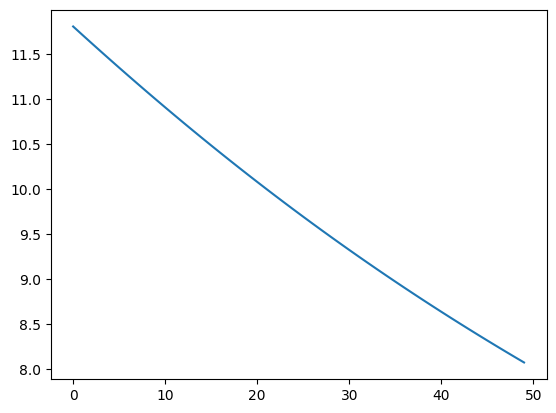
losses = []
for _ in range(50):
  loss = train_step(model, optimizer, ema, x, y)
  losses.append(loss)
plt.plot(losses);
Low Rank Adaptation#
The pattern for adding low rank adaptation to an optimization loop is very similar to adding an exponential moving average. As before, we create a new pytree with the same structure as our model parameters, but here we store low rank additions to these parameters rather than weighted average values.
def add_rank2_lora(path, node):
  if isinstance(node, nnx.Linear):
    return nnx.LoRA(node.in_features, 2, node.out_features, base_module=node, rngs=rngs)
  return node

base_model = make_model(rngs)
lora_model = nnx.recursive_map(add_rank2_lora, base_model)
nnx.display(model)
@nnx.jit
def train_step(model, optimizer, x, y):
  loss, grads = nnx.value_and_grad(loss_fn)(model, x, y)
  optimizer.update(model, grads)
  return loss

optimizer = nnx.Optimizer(
  model,
  tx=optax.adam(1e-3),
  wrt=nnx.LoRAParam,
)

losses = []
for _ in range(50):
  loss = train_step(model, optimizer, x, y)
  losses.append(loss)
LBFGS#
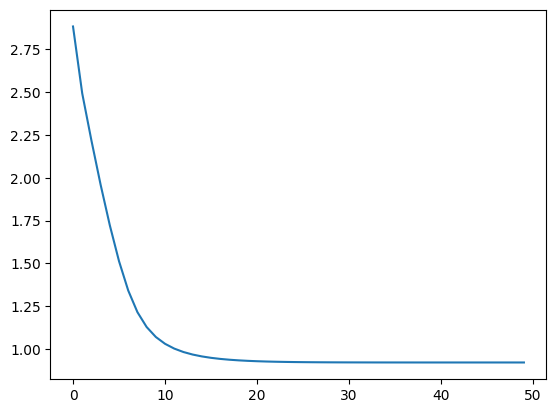
So far, we’ve been using optax optimizers with the interface optimizer.update(grads, opt_state). This works for simple optimization algorithms like ADAM, but for algorithms that use a line search like LBFGS, we need to pass more parameters. Below, we can see how the call to optimizer.update is given additional parameters when using LBFGS.
def train_step(model, optimizer, x, y):
    # Create state-based loss function for LBFGS
    graphdef = nnx.graphdef(model)
    loss_fn_state = lambda state: loss_fn(nnx.merge(graphdef, state), x, y)

    loss, grads = nnx.value_and_grad(loss_fn)(model, x, y)
    optimizer.update(
      model,
      grads,
      grad=grads,
      value=loss,
      value_fn=loss_fn_state)
    return loss

model = make_model(rngs)
optimizer = nnx.Optimizer(
  model,
  tx=optax.lbfgs(1e-3),
  wrt=nnx.Param)

losses = []
for _ in range(50):
  loss = train_step(model, optimizer, x, y)
  losses.append(loss)
plt.plot(losses)
[<matplotlib.lines.Line2D at 0x331a25310>]
Per-Parameter Learning Rates#
In some training regimes, you will want to optimize different parameters with different learning rates.
In Jax, we map from each leaf to the type of parameter it is (weight or bias). We then create a dictionary giving the learning rates to use for each parameter type. Finally, we can make a compound optimizers that uses each rate appropriately.
To do this in Flax, we can map from each leaf to the type of parameter it is (weight or bias). With this pytree of parameter types, we can make a compound optimizer that uses each rate appropriately.
model = make_model(rngs)
state = nnx.state(model, nnx.Param)
rates = {'kernel': optax.adam(1e-3), 'bias': optax.adam(1e-2)}
param_tys = nnx.map_state(lambda p, v: list(p)[-1], state)
optimizer = nnx.Optimizer(model, tx=optax.partition(rates, param_tys), wrt=nnx.Param)

@nnx.jit
def train_step(model, optimizer, x, y):
  loss, grads = nnx.value_and_grad(loss_fn)(model, x, y)
  optimizer.update(model, grads)
  return loss

losses = []
for _ in range(50):
  loss = train_step(model, optimizer, x, y)
  losses.append(loss)
Gradient Accumulation#
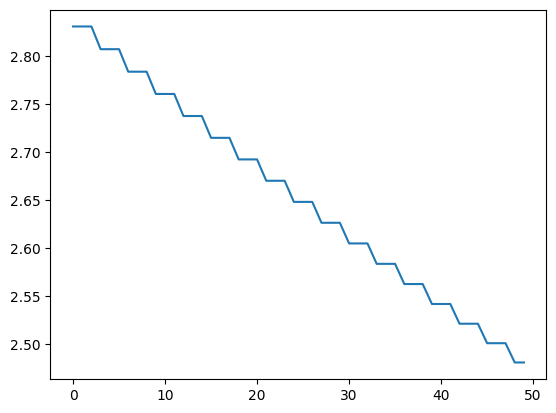
Gradient accumulation in Flax is easy: just use the optax.MultiSteps optimizer.
model = make_model(rngs)
optimizer = nnx.Optimizer(model, tx=optax.MultiSteps(optax.adam(1e-3), every_k_schedule=3), wrt=nnx.Param)

@nnx.jit
def train_step(model, optimizer, x, y):
  loss, grads = nnx.value_and_grad(loss_fn)(model, x, y)
  optimizer.update(model, grads)
  return loss

losses = []
for _ in range(50):
  loss = train_step(model, optimizer, x, y)
  losses.append(loss)
plt.plot(losses)
[<matplotlib.lines.Line2D at 0x3322db110>]
Sharding Optimization State Differently from Parameters#
Say we’re doing data parallelism. We want to replicate our parameters across all GPUs so we can do the forward and backward passes without communication latency.
But we don’t need to replicate the optimizer state, as it’s not invovled in SPMD computations. One copy is enough, and we can shard this copy across our mesh to reduce memory usage. This means that we need the optimizer state to be sharded differently from the parameters themselves. To do this, we can add the ‘optimizer_sharding’ metadata to the initializer.
from jax.sharding import PartitionSpec as P, AxisType, get_abstract_mesh, reshard
mesh = jax.make_mesh((2, 4), ("x", "y"),
                      axis_types=(AxisType.Explicit, AxisType.Explicit))
jax.set_mesh(mesh)

sharded_init = nnx.with_metadata(lecun_normal, optimizer_sharding=P('x', 'y'))
model = make_model(rngs, init=sharded_init)
optimizer = nnx.Optimizer(model, tx=optax.adam(1e-3), wrt=nnx.Param)

@nnx.jit
def train_step(model, optimizer, x, y):
  loss, grads = nnx.value_and_grad(loss_fn)(model, x, y)
  optimizer.update(model, grads)
  return loss

losses = []
for _ in range(50):
  loss = train_step(model, optimizer, x, y)
  model = reshard(model, P(None, None))
  losses.append(loss)
The optimizer state is sharded:
jax.typeof(optimizer.opt_state[0][1].layers[0]['kernel'][...])
ShapedArray(float32[2@x,8@y])
But the model is not:
jax.typeof(model.layers[0].kernel[...])
ShapedArray(float32[2,8])